Twisted Pair Network Cables for Data Transmission and IP Systems
This category features indoor and outdoor twisted pair cables, both shielded (FTP, SFTP) and unshielded (UTP), compliant with CAT5e, CAT6, and CAT6a standards. They provide an ideal solution for stable connections in home and corporate networks, IP camera systems, routers, switches, or PoE devices.
You can choose from gel-filled, UV- and weather-resistant outdoor versions for long runs, as well as more flexible, easy-to-install indoor cables for cable ducts, walls, or rack cabinets. With various lengths available (25–500 m), you can purchase exactly the size you need without unnecessary waste.
- CAT5e FTP / UTP cables for indoor and outdoor use, available in lengths of 25–305 m
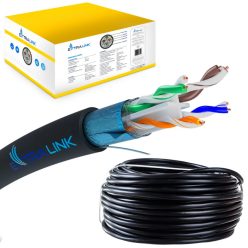
- Gel-filled, UV-resistant outdoor versions for durable, above-ground or underground installations
- CAT6 FTP / UTP twisted pair cables for higher bandwidth networks
- CAT6a FTP indoor cable for high-speed, professional data transmission needs
- Extralink V2 series cables with optimized shielding and reliable signal transmission
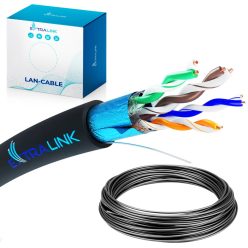
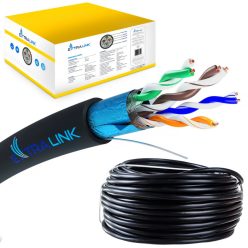
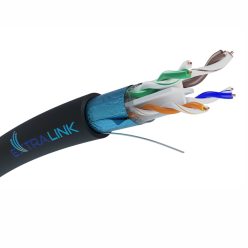
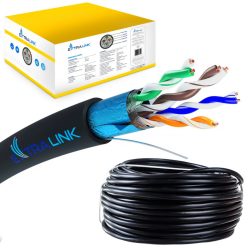

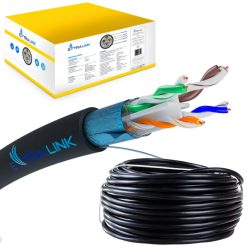
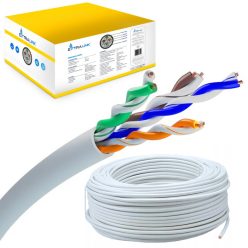
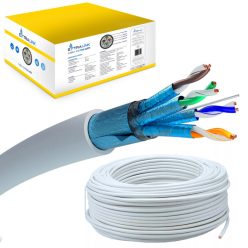
Applications: from home networks to IP surveillance systems
Twisted pair cables are the most commonly used transmission medium in today's Ethernet-based networks. They can be used to connect computers, routers, switches, access points, NAS devices, IP cameras, or VoIP phones, as well as to power PoE-enabled devices. The Extralink CAT5e, CAT6, and CAT6a types in our range cover typical home, small and medium business, and industrial applications.
Indoor or outdoor cable: what’s the difference?
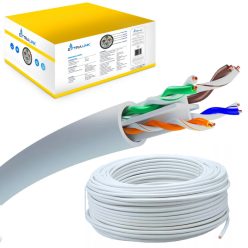
Indoor UTP and FTP cables are primarily recommended for wiring within buildings: routed in wall skirting, cable ducts, or drywall. Outdoor versions, often gel-filled, receive UV-resistant and weatherproof outer insulation that protects the twisted pairs from moisture, temperature fluctuations, and mechanical impacts. These are particularly recommended for outdoor IP cameras and building-to-building connections.
Shielding: UTP, FTP, SFTP – what to pay attention to?
The purpose of shielding is to reduce electromagnetic interference and crosstalk, which is especially important for longer cable runs and noisy industrial environments. The following main types are available in this category:
- UTP (U/UTP) – unshielded, ideal for general office and home networks, suitable for shorter runs.
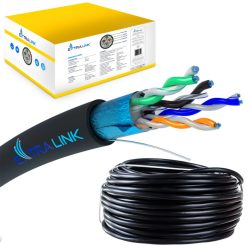
- FTP (F/UTP) – foil shielding around the entire pair bundle, better interference resistance, recommended for PoE and outdoor installations.
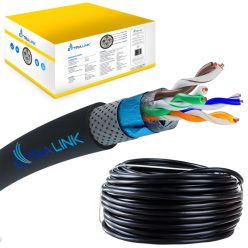
- SFTP (SF/UTP, F/FTP, etc.) – combined foil and braided shielding, specifically for interference-sensitive or high-bandwidth systems.
CAT5e, CAT6, CAT6a – speed and future-proofing
The standard (category) defines the supported bandwidth and maximum data speed. CAT5e cables support up to 1 Gbit/s, CAT6 cables support up to 10 Gbit/s over shorter runs, while CAT6a cables are suitable for permanent 10 Gbit/s installations. If you want a scalable network for the long term, it is advisable to choose at least CAT6, or CAT6a for higher demands, especially for central backbone network segments.
Length, pair material, and installability
The range includes boxed lengths of 25, 50, 100, 305, and 500 meters, allowing you to precisely match the cable length to the installation path. The twisted pair cables, being more flexible, are easier to handle in tighter bends and rack cabinets, while the price and electrical properties of CCA (copper-clad aluminum) and pure copper conductors may vary – especially important for PoE applications and longer runs where the choice of conductor material is crucial.
Buying considerations at a glance
- Usage location: indoor or outdoor, or possibly industrial environment.
- Bandwidth and speed requirements: CAT5e, CAT6, or CAT6a standard.
- Type of shielding: UTP, FTP, SFTP depending on environmental interference.
- Maximum run length and PoE usage: selection of conductor material and cross-section.
- Installation method: cable duct, wall routing, outdoor path, rack arrangement.