Quality twisted pair patch cables for network devices
In this category, you will find various types of Extralink LAN patch cables (Cat.5e, Cat.6, Cat.6a, Cat.7, Cat.8.1) that allow you to build a reliable, high-speed wired network at home, in the office, or in a data center. The pure copper, twisted pair design provides a durable, stable connection with bandwidths of up to 40 Gbps.
You can choose from shielded (FTP, S/FTP, U/FTP) and unshielded (UTP) versions, available in various lengths from 0.5 to 20 meters, in a flexible, connector-protected design. This way, you can easily find the best solution for connecting between a router, switch, patch panel, server, or workstation.
- Cat.5e and Cat.6 patch cables for general office and home networks (Fast Ethernet, Gigabit Ethernet)
- Cat.6a cables up to 10 Gbps for more demanding business and server environments
- Cat.7 and Cat.8.1 cables for 20–40 Gbps, for high-load, professional networks
- UTP, FTP, S/FTP, U/FTP variants with shielding suitable for environmental interference
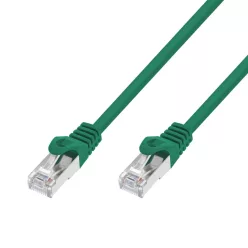
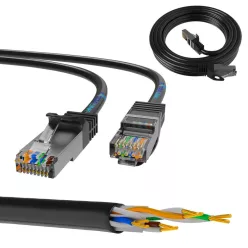
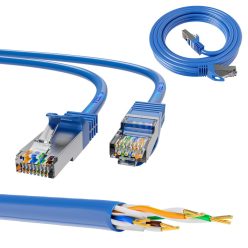
- Lengths between 0.5–20 m, flexible, connector-protected RJ45 connectors
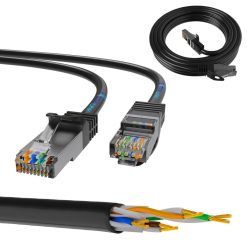
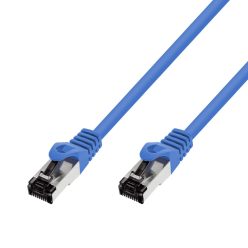
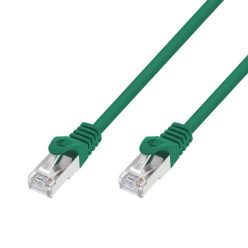
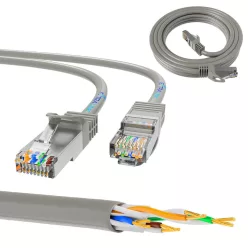
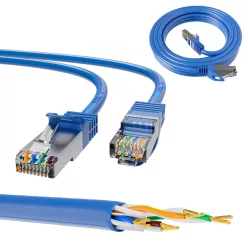
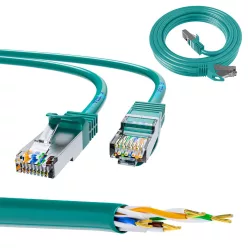
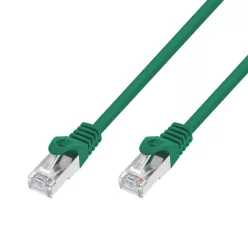
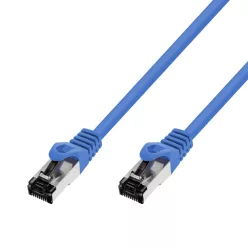
Applications: from home networks to data centers
The range is suitable for everything from simple home internet sharing to corporate office networks, server rooms, and rack cabinets. Short cables of 0.5–2 meters are ideal for connections between patch panels, switches, and servers, while the 5–20 meter types can be used for cabling routers, workstations, IP cameras, access points, and other network devices.
Shielded versions (FTP, U/FTP, S/FTP) are particularly recommended in environments where many electrical devices, power cables, or industrial machines can cause electromagnetic interference. Such areas include office machine rooms, server and data centers, or densely cabled IT cabinets. Unshielded UTP cables provide a cost-effective solution in quiet, interference-free environments.
Technical considerations to help with your choice
When making a decision, it is important to consider the desired transmission speed, the capabilities of the network devices used, and the electromagnetic load of the environment. With Cat.5e and Cat.6 cables, most home and office Gigabit Ethernet networks can be reliably established, while Cat.6a offers headroom up to 10 Gbps, and Cat.7 provides up to 20 Gbps. Cat.8.1 cables are optimized for 40 Gbps and are typically used in server rooms and high-speed backbone networks.
- Category (Cat.5e, 6, 6a, 7, 8.1): determines the maximum bandwidth and future expandability.
- Type of shielding (UTP, FTP, U/FTP, S/FTP): affects interference protection and signal stability.
- Conductor material: pure copper twisted pairs for stable signal transmission and durability.
- Cable length: between 0.5–20 m, avoiding overly long cables reduces losses and cable clutter.
- Stiffness, flexibility: flexible, connector-protected design is advantageous in tight rack cabinets and dense cabling.
Why choose copper twisted pair patch cables?
Extralink cables made with pure copper conductors provide low attenuation, stable signal levels, and long lifespan, especially at higher speeds (10–40 Gbps). The twisted pair design reduces crosstalk and enhances signal quality, which is critical for high-category (Cat.6a, Cat.7, Cat.8.1) cables. Compared to stiffer copper-coated aluminum, pure copper offers a more reliable and load-bearing solution.
The RJ45 connectors are equipped with connector protection and a flexible, break-resistant "boot," which protects the tab from breaking and the cable from damage due to frequent movement and connection. As a result, the cables can be used stably over the long term in tight, loaded patch panels, rack cabinets, or behind workstations.