SFP Modules and Optical Cables for High-Speed Networks
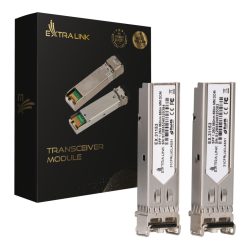
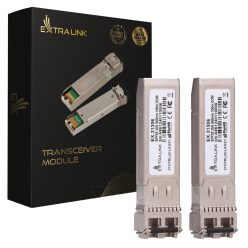
This category includes optical and copper-based connector modules that allow for easy integration of professional networking devices – such as switches, routers, and servers – with various transmission media. Solutions are available for 1.25G SFP, 10G SFP+, 40G QSFP+, and 100G QSFP28, suitable for both short and long-distance connections.
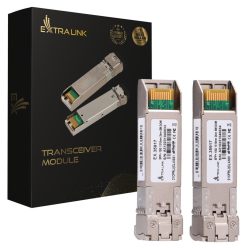
You can choose from single-mode and multi-mode optical modules, DAC and AOC connector cables, CWDM and WDM solutions, as well as types specifically dedicated to HP/Aruba devices. This way, you can easily swap modules in the same port according to the desired speed, connector, and range.
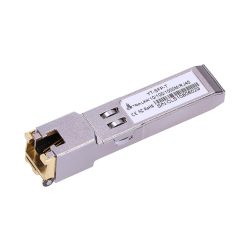
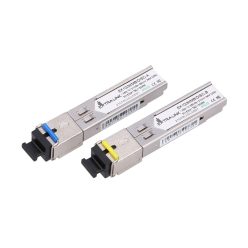
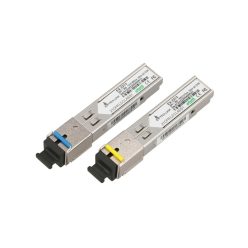
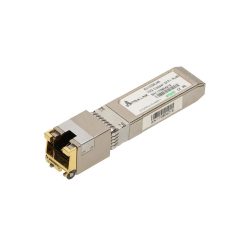
- 1.25G SFP modules – single-mode, multi-mode, WDM, CWDM, with RJ45 copper interface
- 10G SFP+ modules – short and long-distance links, CWDM and WDM solutions, with DOM/DDM support
- QSFP+ and QSFP28 modules – for 40G and 100G uplinks, suitable for data center and backbone network use
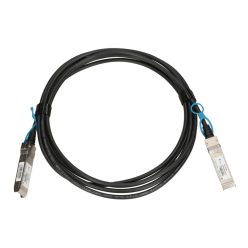
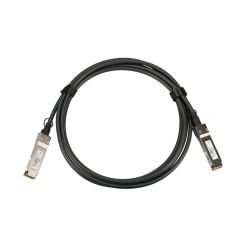
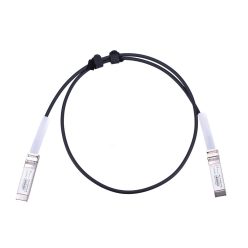
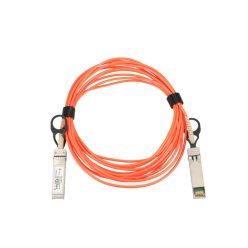
- DAC and AOC cables – cost-effective, low-latency, fixed-length connectors for connections within and between racks
- Manufacturer-specific modules – optimized versions for HP/Aruba environments

Applications: From Office Networks to Backbone Networks
The modules available here can be used to build or expand enterprise, service provider, and data center networks. The 1.25 Gbps SFP solutions are ideal for connecting office switches, smaller backbone segments, camera systems, and remote sites. The 10G SFP+ and 40G/100G QSFP+/QSFP28 modules are designed for high-bandwidth server, storage, and aggregation links.
Single-mode modules – with ranges of up to 80 km – are suitable for connecting remote sites and urban network segments, while multi-mode types offer cost-effective solutions for shorter, typically data center or intra-building connections. WDM and CWDM modules can transmit data over a single fiber pair or even a single fiber at multiple wavelengths, achieving significant fiber savings.
DAC (Direct Attach Copper) and AOC (Active Optical Cable) cables are pre-assembled, factory-terminated connectors that are particularly useful for connections within racks or between adjacent racks. Both passive and active solutions provide extremely low latency and favorable costs while supporting 10G, 40G, or 100G speeds.
Technical Considerations When Choosing a Module
When selecting the right module, several important parameters should be considered to ensure the network operates reliably and at the planned bandwidth.
- Speed: 1.25G, 10G, 40G, or 100G – this determines the supported network standards (e.g., 1000BASE-LX, 10GBASE-LR, 40GBASE-SR4).
- Range and Optical Mode: multi-mode modules for short (tens to hundreds of meters), single-mode for links of several kilometers or up to 80 km.
- Wavelength: 850 nm, 1310 nm, 1550 nm, or CWDM/WDM combinations (e.g., 1470–1610 nm), which affect compatibility and maximum distance.
- Connector Type: LC, SC, RJ45, or MPO – must match existing patch panels and cabling.
- DOM/DDM Support: monitoring of optical performance, temperature, and voltage for easier network diagnostics.
- Compatibility: general-purpose or specifically dedicated modules for HP/Aruba devices to meet the expectations of the network manufacturer.
Where to Use Different Types?
For short, high-speed connections (server-to-switch, switch-to-switch within a rack), DAC and AOC cables often provide the best cost-performance ratio. For medium distances within buildings, multi-mode, 850 nm SFP/SFP+ modules are commonly used. If multiple sites, levels, or buildings need to be connected, it is advisable to choose single-mode, 1310/1550 nm, or CWDM modules that offer greater distance and better future scalability.
In a dedicated HP/Aruba environment, it is worth relying on dedicated Extralink modules, which operate according to the manufacturer's expectations in terms of firmware compatibility. By selecting the appropriate module and cable type, a stable, future-proof, high-bandwidth optical infrastructure can be built.