Fiber Optic Splitters for High-Speed Optical Networks
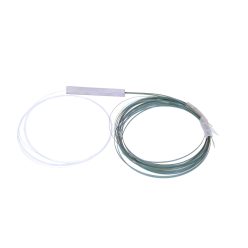
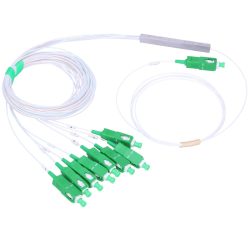
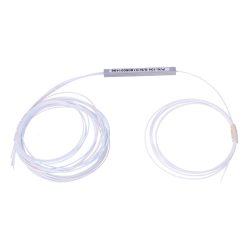
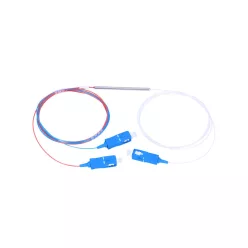
In this category, you will find various Extralink fiber optic splitters that allow the signal of GPON, FTTH, FTTB, and other optical networks to be distributed among multiple users. Solutions using both PLC and FBT technology are available, with different splitting ratios, connector types, and cable structures.
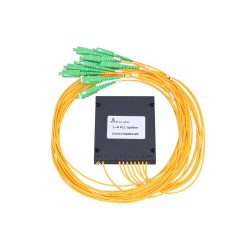
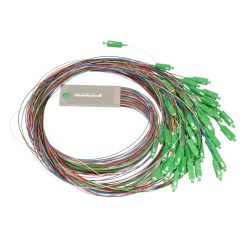
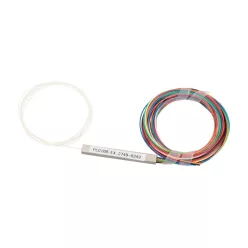
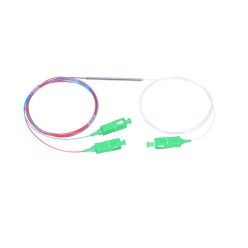
You can choose from SC/APC or SC/UPC connector types, as well as connectorless versions, with splitting ratios ranging from 1:2 to 1:64. The range includes compact ABS modules, steel box versions, splitters with 250 µm, 900 µm, and 2.0 mm jackets, as well as special CWDM ITBMUX modules.
- Looking for a PLC fiber optic splitter for general, stable splitting (1:2, 1:4, 1:8, 1:16, 1:32, 1:64).
- Need an FBT splitter for asymmetric power ratios (e.g., 15:85, 25:75, 35:65, 45:55).
- Want a solution with SC/APC or SC/UPC connectors, or connectorless for splicing.
- Searching for a splitter that can be mounted in an ABS module, steel box, or slot type.
- Need a CWDM ITBMUX module in the 1511–1571 nm wavelength range.

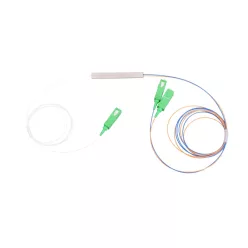
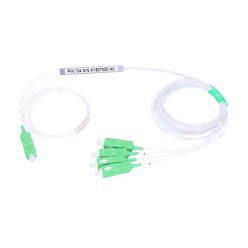
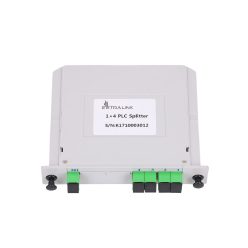
Applications of Fiber Optic Splitters
Fiber optic splitters are essential components of every modern optical network: they enable a single incoming optical fiber signal to be distributed among multiple outputs. Typical applications include GPON/EPON hubs, FTTH residential networks, FTTB/FTTO office buildings, industrial optical backbone networks, as well as camera systems and other high-bandwidth data transmission applications.
PLC (Planar Lightwave Circuit) splitters provide stable, precise splitting ratios and good wavelength independence, making them ideal for larger splitting ratios (1:8, 1:16, 1:32, 1:64) and passive optical networks. FBT (Fused Biconical Taper) splitters offer flexible solutions that can even accommodate asymmetric power ratios (e.g., 15:85, 25:75, 35:65, 45:55, 5:95) when certain branches require higher signal levels than others.
Main Technical Considerations When Choosing
Before purchasing, it is worth considering the splitting ratio, connector type, cable diameter, and installation environment. 1:2 and 1:4 splitters have lower losses and are ideal for shorter runs and fewer subscribers, while 1:8–1:64 solutions have higher attenuation, so the overall optical budget must be carefully planned. SC/APC connectors are primarily common in GPON/FTTH and RF overlay applications, while SC/UPC versions are typically used in data and telecommunications lines.
The jacket size (250 µm, 900 µm, 2.0 mm) determines where and how the splitter can be installed: the 250 µm and 900 µm versions can be easily integrated into splice cassettes, while the 2.0 mm versions provide a more durable, mechanically resistant solution for patch panels and cabinets. ABS modules and steel box splitters allow for organized, protected installations, especially in server and telecommunications cabinets.
- Splitting ratios: 1:2, 1:4, 1:8, 1:16, 1:32, 1:64; special ratios for FBT (5:95–45:55).
- Connectors: SC/APC, SC/UPC, or connectorless, splicable versions.
- Cable jacket: 250 µm, 900 µm, 2.0 mm, also with G657A fibers.
- Design: bare splitter, ABS module, steel box, slot type, divisible solutions.
The special 1x4 ITBMUX CWDM modules enable the transmission of multiple signals over a single fiber in the 1511–1571 nm wavelength range, making them ideal for systems where fiber capacity is limited but multiple independent channels are needed. This way, the network's throughput and flexibility can be increased while using the same infrastructure.