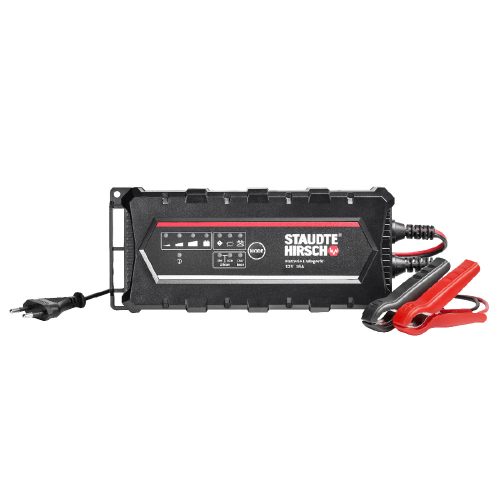
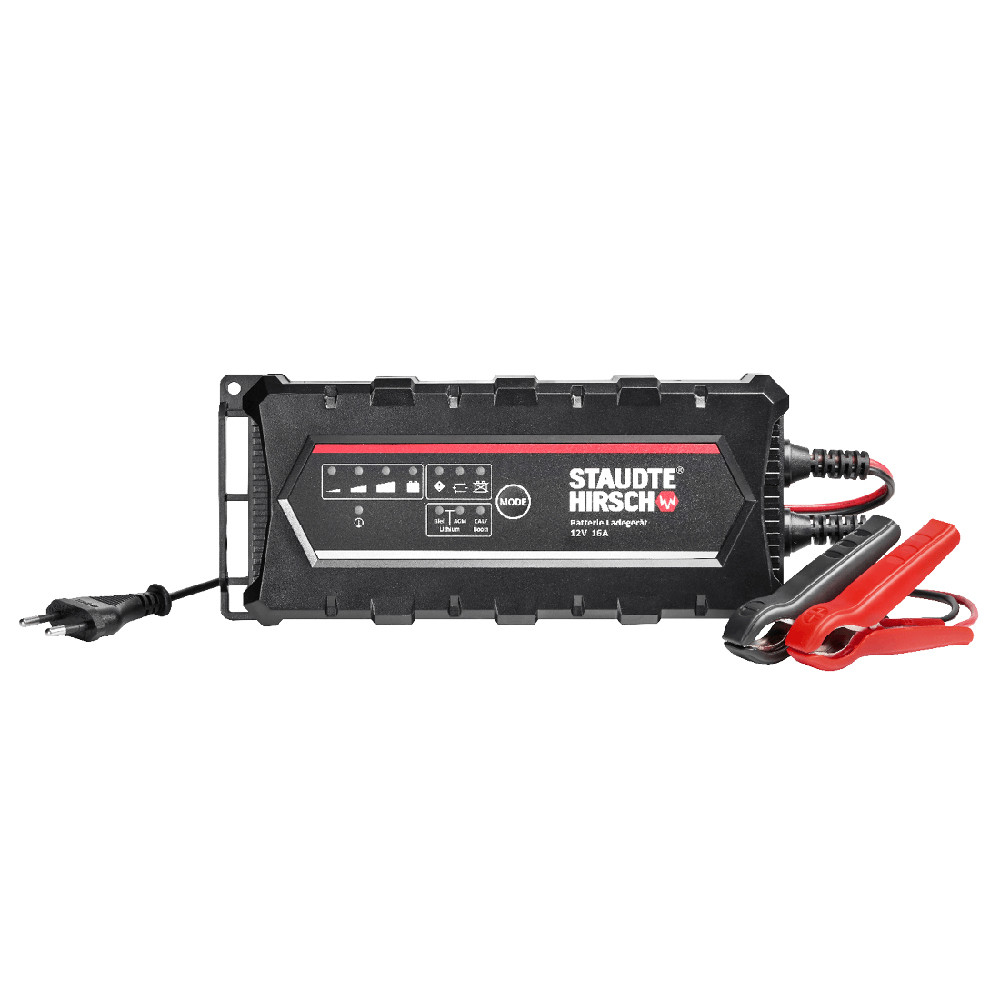
Professional quick charger with high charging current – significantly reduces the charging time of large batteries
Features & Functions
Advantages of the intelligent, multi-step charging
The fully automatic multi-step charging method guarantees that your battery is charged fully and gently in the shortest possible time and according to its type. Mode Specification AGM Battery type: 12 V AGM Battery capacity: from 30 Ah Charging current: 16 A Cut-off-voltage: 14.7 V SLA/Gel Battery type: 12 V lead-acid 12 V lead-gel Battery capacity: from 30 Ah Charging current: 16 A Cut-off-voltage: 14.4 V Lithium Battery type: 12 V LiFePO 4 with BMS Battery capacity: from 30 Ah Charging current: 16 A Cut-off-voltage: 14.4 V Calcium/Boost Battery type: 12 V Calcium Battery capacity: from 30 Ah Charging current: 16 A Cut-off-voltage: 16.0 V
Regeneration step for the reactivation of deep discharged batteries
When a battery is connected to the charger, the device first determines independently what the charging status of the battery is (deep discharged, partially discharged). If the battery is detected as deep discharged, the charging process will automatically start in regeneration mode. A lower charging current is used to bring the deep discharged battery back to a voltage at which the regular charging function can be started. Should this be no longer possible, the battery is detected as defective and the error is indicated by an optical signal.
Float charging phase – ideal for longer periods of inactivity
Thanks to the float charging phase included in the multi-step charging process, the battery capacity is constantly monitored, optimally recharged if necessary and capacity losses due to self-discharge are compensated immediately. This fully automatic feature guarantees the instant operability of your vehicle at all times and ensures that your battery is fully efficient even after long periods of inactivity.
Integrated: auto-memory function
The auto-memory function ensures that the battery charger returns automatically to the previously selected mode after power is restarted following a supply voltage failure.
Safe operation – protection against short circuit, reverse polarity and overcharging
Defective, short-circuited or reverse-poled rechargeable batteries are automatically detected by the charger and indicated by visual warning signals.
Clear display – easy to use
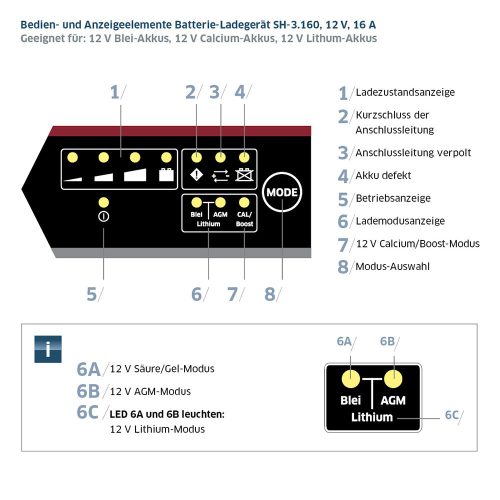
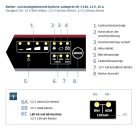
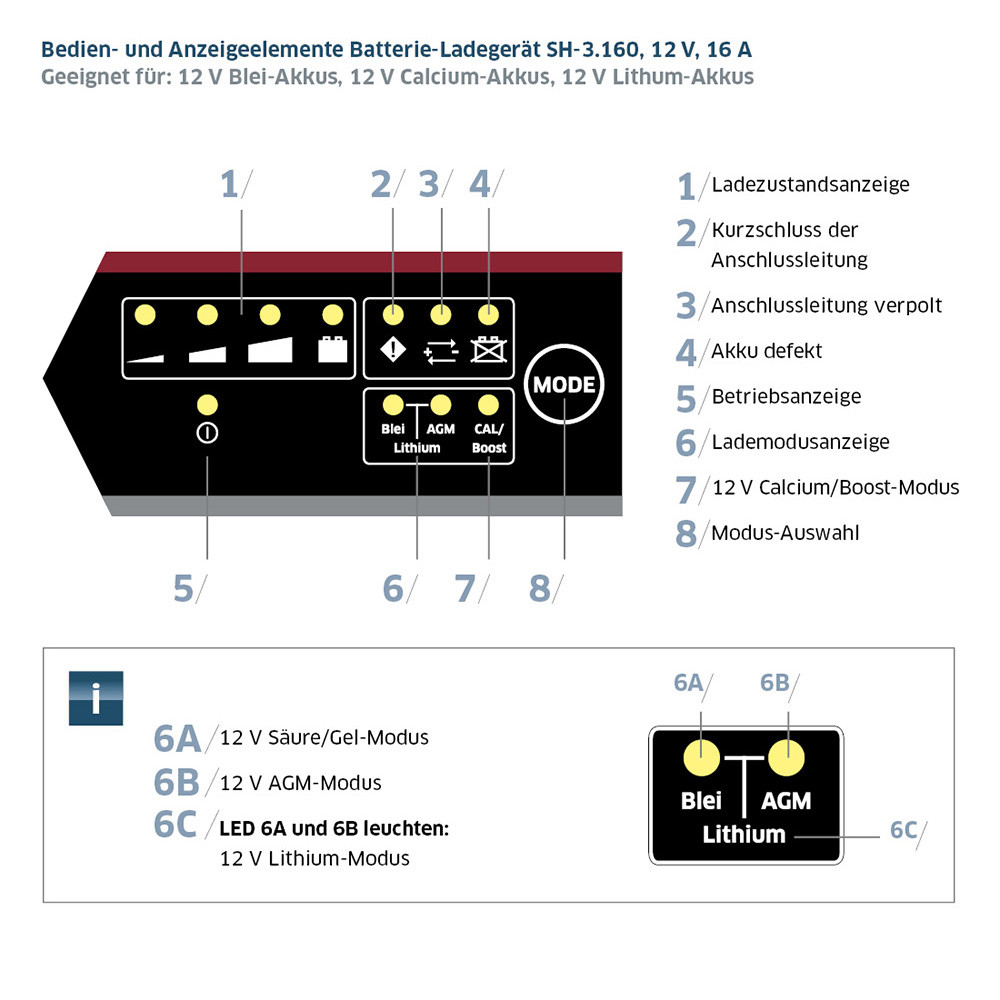
Clear operation and display panel 1 Charging status indicators 2 Short circuit of connection cable 3 Connection cable with reverse polarity 4 Battery defective 5 Operating display 6 Charging mode indicators 7 12 V Calcium/Boost mode 8 Mode selection The Battery Charger SH-3.160 is equipped with a clear operation and display panel. The LEDs inform you about the chosen operating mode, the charging status of the rechargeable battery as well as a short-circuited, defective or reverse-poled rechargeable battery at any time. With the MODE button you can easily and conveniently select the desired settings or charging method.
12 V AGM mode
The 12 V AGM mode is suitable for charging 12 V AGM batteries from 30 Ah. The maximum charging current is 16 A. The final charge voltage is 14.7 V. Step 1: Softstart phase The first charging step serves to put a deep discharged battery back into a chargeable state. The softstart phase is not necessary, if the battery voltage is at least 10.0 V. Step 2: Bulk phase In this step, the battery is constantly charged with max. 16 A charging current. Step 3: Absorption phase In step 3, the battery is charged with constant voltage. Step 4: Floating phase After reaching the cut-off-voltage (14.7 V), the battery is constantly supplied with current. Capacity losses through self-discharge are compensated immediately.
12 V SLA/Gel mode
The 12 V SLA/Gel mode is suitable for charging 12 V lead-acid and lead-gel batteries from 30 Ah. The maximum charging current is 16 A. The final charge voltage is 14.4 V. Step 1: Softstart phase The first charging step serves to put a deep discharged battery back into a chargeable state. The softstart phase is not necessary if the battery voltage is at least 10.0 V. Step 2: Bulk phase In this step, the battery is constantly charged with max. 16 A charging current. Step 3: Absorption phase In step 3, the battery is charged with constant voltage. Step 4: Floating phase After reaching the cut-off-voltage (14.4 V), the battery is constantly supplied with current. Capacity losses through self-discharge are compensated immediately.
12 V Lithium mode
The 12 V Lithium mode is suitable for charging 12 V LiFePO 4 batteries from 30 Ah with integrated battery management system. The maximum charging current is 16 A. The final charge voltage is 14.4 V. Step 1: Check phase If the battery management system (BMS) is switched off due to low battery voltage, it is reactivated by a control signal from the battery charger. The charging process does not start until then. Step 2: Softstart phase The softstart phase serves to put a deep discharged battery back into a chargeable state. This charging step is not necessary if the battery voltage is at least 10.0 V. Step 3: Bulk phase In this phase, the battery is constantly charged with max. 16 A charging current. Step 4: Absorption phase In this charging step, the battery is charged with constant voltage. Step 5: Floating phase After reaching the cut-off-voltage (14.4 V), the battery is constantly supplied with current. Capacity losses through self-discharge are compensated immediately.
12 V Calcium/Boost mode
The 12 V Calcium/Boost mode is suitable for charging 12 V calcium batteries from 30 Ah or for regenerating deep discharged/sulphated 12 V lead-acid batteries from 30 Ah. The maximum charging current is 16 A. The final charge voltage is 16 V. Step 1: Softstart phase The first charging step serves to put a deep discharged battery back into a chargeable state. The softstart phase is not necessary if the battery voltage is at least 10.0 V. Step 2: Bulk phase I In this step, the battery is constantly charged with max. 16 A charging current. Step 3: Absorption phase I In step 3, the battery is charged with constant voltage (14.7 V). Step 4: Check phase The charger checks if the battery can hold the charge. Step 5: Bulk phase II The battery is charged constantly with a reduced charging current of 5 A until the cut-off-voltage is reached. Step 6: Absorption phase II The battery is constantly supplied with voltage (16 V) until it is fully charged. Step 7: Floating phase The battery is constantly supplied with voltage (13.6 V). The trickle charge occurs with reduced charging current.
3 year manufacturer warranty
Products of IVT and Staudte Hirsch are manufactured to a high quality and following strict quality guidelines. We are certain about the longevity so that we add another year to the statutory manufacturer warranty free of charge (rechargeable batteries excluded).
Delivery content
Battery Charger Staudte Hirsch SH-3.160, 12 V, 16 A Instruction manual in DE, GB
Technical Data
| Parameter | Value |
|---|
| Operation voltage | 220 - 240 V AC, 50/60 Hz |
| Input current (max.) | 1.25 A |
| Power consumption | 270 VA |
| Suitable battery voltage | 12 V |
| Charging current | 16 A ± 10 % AGM, SLA/Gel,Lithium, Calcium/Boost mode |
| Rechargeable battery type | 12 V lead batteries (Acid, Gel, AGM)12 V calcium batteries12 V LiFePO4batteries |
| Battery capacity | From 30 Ah AGM, SLA/Gel,Lithium, Calcium/Boost mode |
| Charging method | Multi-step |
| Cut-off-voltage | 14.4 V ± 0.25 V Lithium mode14.4 V ± 0.25 V SLA/Gel mode14.7 V ± 0.25 V AGM mode16.0 V ± 0.25 V Calcium/Boost mode |
| Reverse current | < 0.5 mA |
| IP protection | IP 20 |
| Cable length | 1.70 m (mains cable)1.60 m (connection cable incl. adapter) |
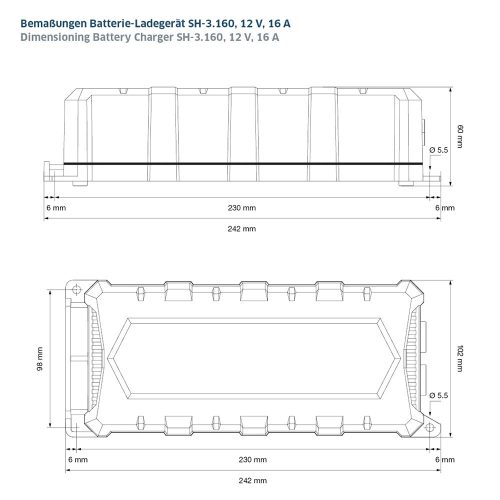
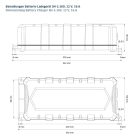
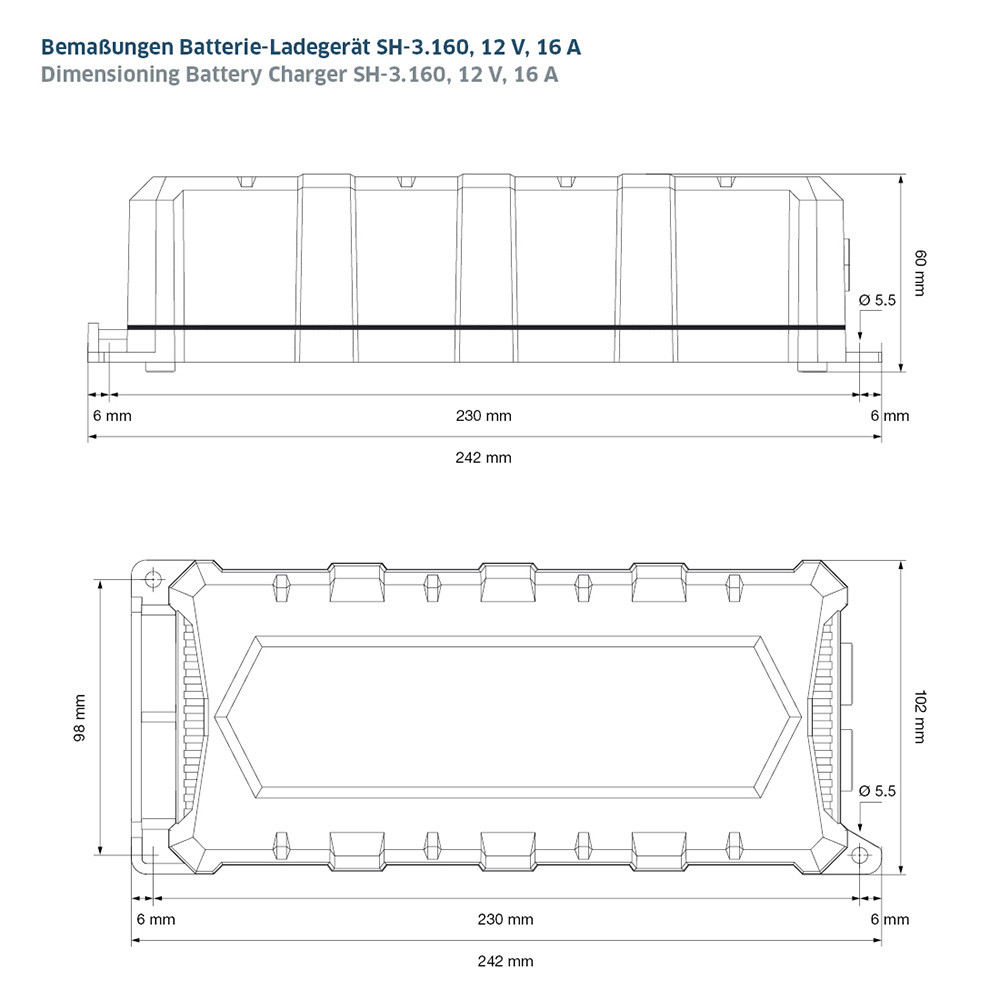
| Dimensions (L x W x H) | 242 x 102 x 60 mm |
| Weight | 960 g |

 German Quality