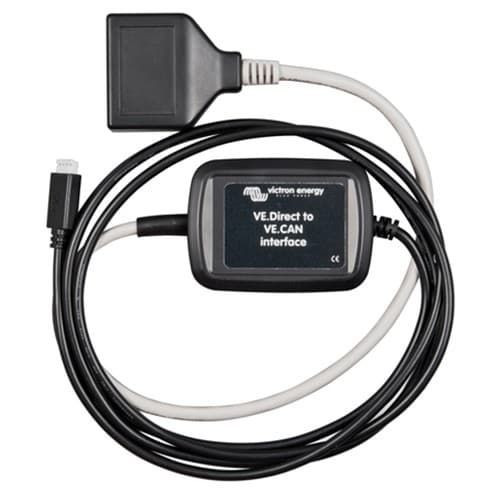
Universal communication bridge for VE.Bus and VE.Can systems
This converter establishes a reliable connection between VE.Bus-based inverters, inverter chargers, and other devices, and equipment connected to the VE.Can communication network. It is an ideal solution when you want to expand, monitor, or integrate an existing Victron system into a central energy management system without replacing the entire infrastructure.
Main benefits and application areas
The converter allows energy electronic devices using different communication protocols to work together effectively. This is particularly useful in complex solar, off-grid, or hybrid systems where multiple inverters, battery chargers, monitoring, and control units operate together.
- Ensuring data communication between VE.Bus and VE.Can devices
- Facilitating system monitoring and remote monitoring
- Compatibility with existing Victron components
- Flexible expandability and integration into larger systems
- Stable, reliable communication for industrial and residential use
Application in complex power supply systems
In modern solar and hybrid power supply systems, it is increasingly common for multiple communication buses to run in parallel. The converter's role is to unify these separate networks into a common system, allowing monitoring devices – such as energy monitors, data loggers, or remote monitoring units – to gain a comprehensive view of the entire installed system.
It is particularly useful in the following types of systems:
- Off-grid power supply systems
- Grid-tied, battery-based hybrid systems
- Industrial backup power supply (UPS, critical loads)
- Power supply for yachts, houseboats, and RVs
- Power supply for telecommunications stations and remote measuring points
Easy integration with VE.Bus devices
Devices communicating via VE.Bus, such as inverters, inverter chargers, and voltage regulators, are key elements of everyday power supply. With the converter, these devices can easily be incorporated into a broader VE.Can network, where centralized data logging, monitoring, and control can be implemented.
When connected to the VE.Bus side, the converter:
- Reads system-level status indicators and measurement data
- Transmits key parameters to the VE.Can network
- Helps synchronize and transparently control the entire system
- Enables unified management of configuration and monitoring
Reliable connection to the VE.Can network
VE.Can is an industrial-grade, stable communication bus ideal for managing larger systems, multiple parallel devices, and extensive power supply infrastructure. The converter ensures that data from VE.Bus side inverters and other devices appear in the correct format on the VE.Can network.
VE.Can features include:
- Bus topology allowing for longer cabling
- Reliable data communication even in noisy industrial environments
- Ability to connect multiple devices simultaneously
- Integration of centralized monitoring and control interface
Keywords and functions from an SEO perspective
The device is an ideal choice for those looking to implement communication conversion in a solar or hybrid power supply system, switching between bus protocols, or integrating VE.Bus and VE.Can. Thanks to the communication adapter function, the system's monitoring, remote supervision, and data collection will be significantly simpler and clearer.
- Communication converter for VE.Bus and VE.Can connection
- Expanding and integrating energy management systems
- Monitoring and controlling solar systems
- Remote monitoring of inverters and battery systems
- Modular, expandable Victron power supply networks
Recommended for:
The product is recommended not only for professionals but also for conscious users operating more complex energy systems who want to monitor them uniformly. It can be a key element in the system architecture for designers, electricians, and system integrators.
- Installers and system integrators using multiple communication buses
- Users building a central energy management system
- Operators of larger solar or hybrid systems
- Yacht and RV builders, designers of onboard power supply systems
- Professionals responsible for energy monitoring in industrial and commercial facilities
Installation and commissioning
The device is easy to install, but it is recommended to involve a qualified installer to ensure proper setup of communication networks. The VE.Bus and VE.Can connections are clearly marked, making correct wiring easy. The network configuration depends on how many and what type of devices are connected and what monitoring system is used.
Typical installation steps generally include:
- Connecting the VE.Bus cable to the de-energized system
- Wiring the VE.Can network connections to the bus
- Checking terminations on the VE.Can side
- Powering up the system and checking communication
- Configuring monitoring or control software (if necessary)
Why is communication compatibility important?
The efficiency of a modern energy system depends not only on the quality of inverters, solar panels, or batteries but also on how well the individual elements can