Reliable power supply for all devices
In this category, you will find power supply cables and connectors that allow you to safely and securely power your computers, monitors, uninterruptible power supplies, servers, or household appliances. With various connector types and cable lengths, you can choose the exact solution that fits your specific device.
Our range extends from classic 230 V power cables to solutions with IEC (C13, C19, etc.) connectors, all the way to more specialized cables intended for industrial use. This makes it easy to find the right cable for home, office, and server room use.
- Power cables for PCs, monitors, printers
- IEC power cables for servers, rack cabinets, UPSs
- Extension cords and power strips with shorter or longer wires
- Special connector, industrial, and professional power cables
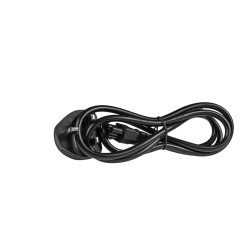
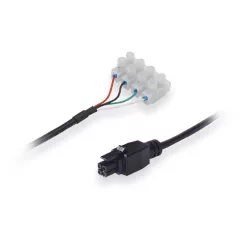
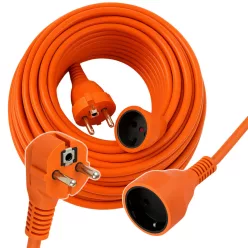
Applications: home, office, server room
Choosing the right power cable is essential for safe and stable operation, whether it's for a home computer, office workstation, or high-load servers. Different devices have varying connectors and power requirements, so it's important to use a cable that matches the load, environment, and power consumption.
In home and office environments, standard 230 V power cables, as well as IEC C13 and C5 (commonly known as "Mickey Mouse") connectors, are the most common, which can be used for monitors, PCs, laptop chargers, and other peripherals. In server rooms and rack cabinets, C19 and C20 types, designed for higher current loads, are common, as well as color-coded cables that make it easier to separate circuits and redundant power supplies.
Technical considerations for selection
When purchasing, it's important to pay attention to several key parameters: the type of connector, the rated current and voltage, the wire cross-section (e.g., 0.75 mm², 1.0 mm², 1.5 mm²), the quality of insulation, and the desired length. A cable that is too thin or not rated for the proper load can cause overheating, while a cable that is too long can lead to voltage drop and a messy cable tangle.
- Connector type: device and socket compatibility (e.g., Schuko, IEC C13/C19, special industrial plugs).
- Current capacity: rated current adjusted to the device's power consumption.
- Cable cross-section: larger loads require larger copper cross-sections.
- Length: should only be longer than necessary for organized and safe cabling.
- Quality certifications: CE, possibly compliance with additional standards.
Safety, reliability, and organized cabling
Quality power cables not only reduce the risk of failures and voltage fluctuations but also contribute to fire safety and electrical security. It is important to regularly check the cables for any breaks, damage, or exposed wires, and replace them in a timely manner if necessary.
It is also advisable to plan the length and arrangement of the cables in advance. Using cables of the appropriate length can help avoid dangerous tensions, unnecessary extensions, and tangled cable messes. Well-chosen power cables thus not only support the stable operation of devices but also play a key role in creating a transparent and easily maintainable working environment.