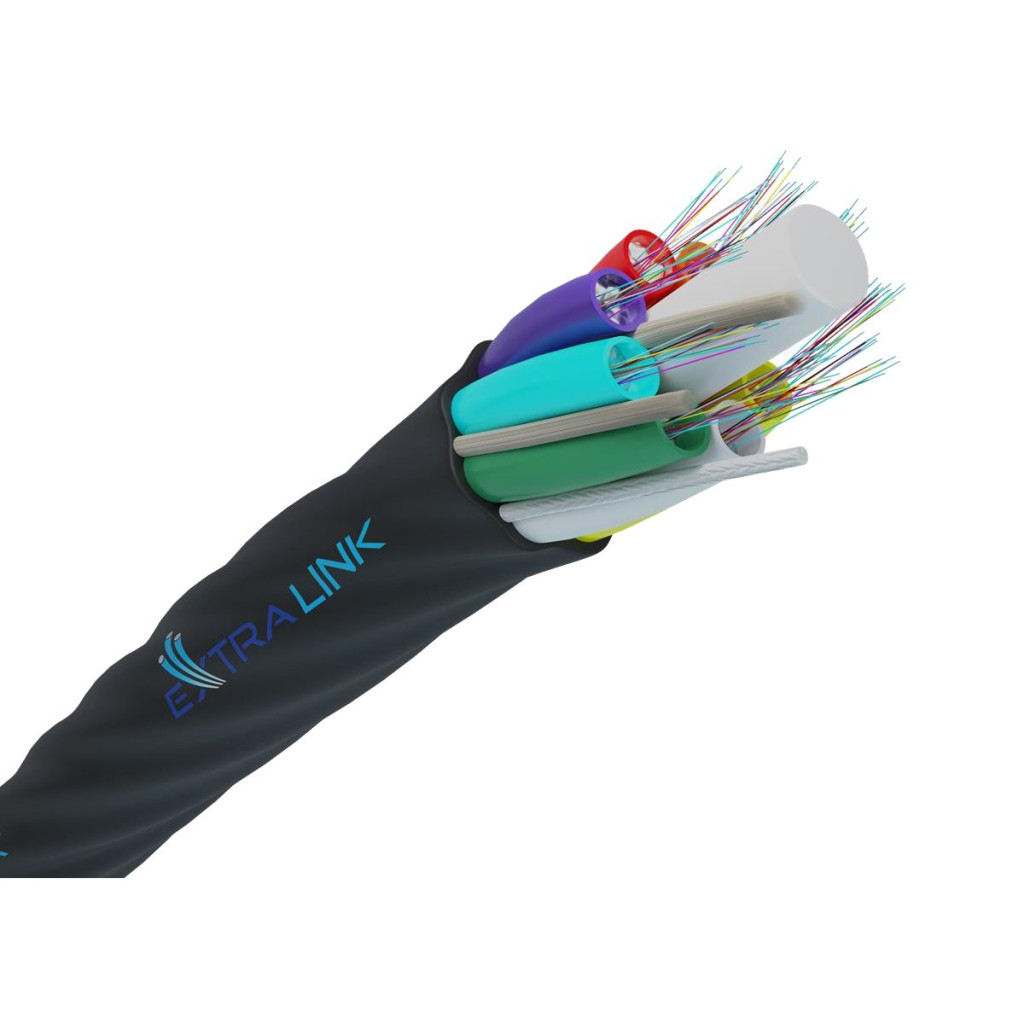
Optical cable for microtubing networks
This high-density, 96-fiber optical cable developed for microtubes is an ideal choice for building modern, high-capacity telecommunications and data transmission networks. Thanks to its compact, only 6.1 mm outer diameter, it can be blown into microtubes, providing an efficient and cost-effective solution for long-term network expansion.
Main features and benefits
- 96 optical fibers (8x12 fibers) for high-bandwidth data transmission
- G.652D single-mode fiber type – low loss, long range
- Optimized for microduct installation, 6.1 mm outer diameter
- Reliable data communication in backbone and distribution networks
- Robust construction, good mechanical resistance
- Extralink quality – stable performance and long lifespan
Advantages of G.652D single-mode fibers
The G.652D standard optical fibers in the cable have excellent parameters that are essential for modern optical networks. These fibers provide low loss and minimal chromatic dispersion across the entire wavelength range, typically between 1310 nm and 1550 nm.
- Low loss for long-distance data transmission
- Reliable operation in FTTH, FTTB, FTTx systems
- Compatible with most common optical transmission technologies
- Suitable for high-speed internet, IPTV, VoIP, and corporate data connections
96-fiber structure (8x12 fibers)
The 96 optical fibers are arranged in 8 bundles, each containing 12 fibers. This structure allows for efficient cable management, easier identification, and flexible network building. The high fiber capacity ensures that the cable provides sufficient reserves for expanding demands in the long term.
- High fiber capacity in a single cable
- Easy labeling and identification thanks to the bundled structure
- Ideal for serving multiple services and multiple customers
- Future-proof solution for network expansion
Microduct installation and small diameter
One of the biggest advantages of the cable is its small outer diameter of only 6.1 mm, which makes it suitable for microduct installation. Microduct optical networks allow for blowing technology, making cable installation faster, requiring less physical work, and significantly reducing construction costs.
- Optimal size for microtubes
- Easy to install with blowing technology
- Shorter construction time, lower labor costs
- Minimal environmental impact, less excavation work
Applications
This optical cable developed for microtubes can be widely used in various network environments. It provides reliable data transmission in the enterprise, service provider, and municipal segments, but is also ideal for smaller, local optical networks.
- Metropolitan and backbone networks
- FTTH and FTTx access networks
- Corporate and industrial optical connections
- Connections between data centers and server farms
- Urban and municipal optical infrastructures
Installation and operational benefits
A properly designed optical cable is important not only for its excellent transmission technical parameters but also offers numerous advantages during installation and operation. This solution enables a long-term stable, low-maintenance optical network.
- Cost-effective infrastructure
Thanks to the high fiber capacity, a single cable can serve multiple services and multiple customers, thus requiring fewer cables, connections, and fittings.
- Flexible scalability
The spare optical fibers can be brought into service later without needing to install new cables. This simplifies network expansion and reduces future investment needs.
- Reliable data transmission
The G.652D fiber and stable cable construction ensure low signal loss and high data transmission speed, even over long distances.
- Long lifespan
The robust design and Extralink manufacturer quality guarantee that the cable withstands adverse environmental effects and mechanical stress.
Why is a microduct optical cable advantageous?
Microduct technology is a key element of modern optical networks. Smaller diameter cables can be blown into microtubes, making network design and expansion significantly more flexible.
- Modular network construction – cables can be blown into pre-laid microtubes at any time later
- Smaller diameter, lower weight – easier handling in the field
- Lower material and labor costs compared to a traditional, large-diameter optical cable
- Greater operational reliability, simpler troubleshooting
Key technical parameters
The most important technical parameters summarized:
- Number of optical fibers: 96
- Fiber distribution: 8 bundles x 12 fibers
- Fiber type: G.652D single-mode optical fiber
- Outer diameter: approx. 6.1 mm
- Application area: microtubes, blowing installation, optical backbone and distribution networks
Summary
This 96-fiber Extralink optical cable optimized for microtubes is an ideal solution for high-density, high-bandwidth networks. Its compact design allows for easy installation in microtubing infrastructures, while the G.652D single-mode fibers provide stable, low-loss data transmission in the long term. The high fiber capacity, flexible scalability, and reliable performance make it an attractive choice for providers, system integrators, and corporate users alike.