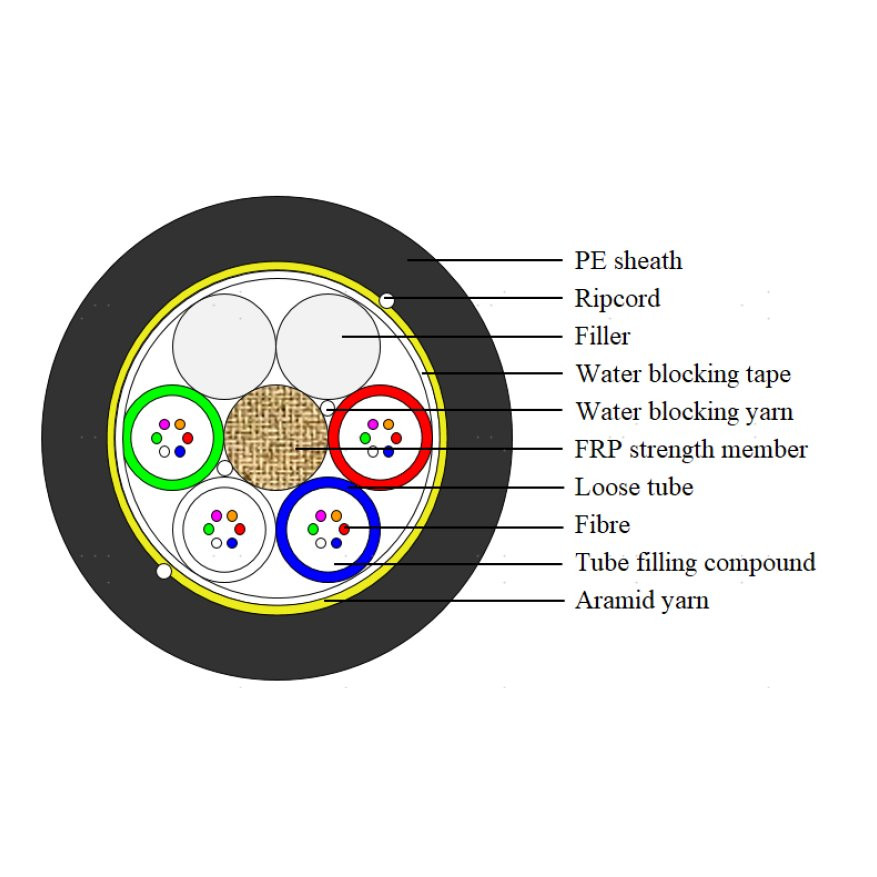
Aerial optical cable for outdoor networks – reliable backbone solution
This professional, self-supporting (ADSS – All Dielectric Self Supporting) optical cable is specifically designed for aerial installation. It is an ideal choice for telecommunications providers, corporate networks, industrial facilities, and any location where a high-reliability, long-term outdoor data transmission solution is needed. The 24 optical fibers with G.657A1 standard flexible design allow for fast, stable, and high-bandwidth communication even under unfavorable installation conditions.
Main features and benefits
- 24 optical fibers (2×12 fiber structure) for high-capacity data transmission
- G.657A1 type flexible optical fiber – excellent reduced bending loss
- Fully dielectric construction – no need for lightning protection, does not conduct electricity
- ADSS, self-supporting construction – can be installed on poles without a separate support cable
- 3 kN tensile strength – high mechanical load capacity for aerial suspension
- Approximately 10 mm outer diameter – stable and resistant design
- UV-resistant, weatherproof sheath – reliable operation under extreme outdoor conditions
- Suitable for medium and long-distance backbone networks, FTTx, industrial and urban optical systems
Areas of application
The aerial optical cable is excellently applicable in both residential and industrial environments. It is specifically recommended for:
- FTTH/FTTx networks for subscriber sections and distribution networks
- Urban and intercity optical backbone networks installed on pole routes
- Telecommunications systems running parallel to electrical networks
- Data communication networks between industrial parks, factories, logistics centers
- Long-distance connections for security, IP camera, and monitoring systems
G.657A1 optical fiber – high flexibility, low loss
The G.657A1 standard optical fibers in the cable are specifically optimized for small bending radius. This means that the cable:
- better withstands bends, tight curves, and fixing points
- shows less increase in attenuation when bent compared to traditional G.652D fibers
- is suitable for modern, densely installed optical systems and tight cable ducts
As a result, the built optical network operates more stably with less signal loss, which is critical for high-speed internet, VoIP, IPTV, and other data-intensive services.
ADSS – self-supporting, fully dielectric design
The essence of ADSS (All Dielectric Self Supporting) technology is that the cable:
- does not contain metallic reinforcing elements, thus does not conduct electricity
- can be directly suspended on poles without a separate steel wire
- reduces the risk of lightning strikes and potential differences
- provides a safe solution even near electrical overhead lines
The dielectric structure simplifies design, increases network operational reliability, and minimizes grounding requirements.
Mechanical resistance and durability
The cable's 3 kN tensile strength allows it to be safely installed even at larger pole distances while resisting:
- wind loads
- ice and snow loads
- mechanical stress at tension and support points
The robust, approximately 9.8 mm outer diameter sheath effectively protects the optical fibers from environmental effects and ensures the cable's long service life.
Weather and UV-resistant outdoor sheath
The cable's outer sheath is made from UV-resistant and weatherproof material, thus resisting:
- intense sunlight, aging caused by UV radiation
- extreme temperatures
- precipitation, humidity, and contaminants
This is particularly important for aerial optical networks, where the cable is continuously exposed to external conditions.
Installation and manageability
The cable design serves easy, fast, and secure installation:
- self-supporting structure – no need for a separate support wire
- optimal diameter – manageable with suspension and securing accessories
- markings facilitate fiber identification during cable termination
Thanks to the smaller bending radius, the fibers can be more easily connected to optical patch panels, distribution boxes, or splicing cassettes. This reduces installation time and the potential for errors.
Typical application examples
- Aerial construction of urban optical rings and backbone networks on utility poles.
- Optical connections for FTTH/FTTB infrastructure between provider centers and subscriber nodes.
- Data connections between buildings in industrial facilities (factories, warehouses, industrial parks).
- Long-distance, interference-protected data transmission for security and IP camera systems.
- Construction of telecommunications optical routes next to electrical networks.
Why is this aerial optical cable a good choice?
- Reliable data transmission over long distances, with low attenuation.
- Cost-effective installation – no need for a separate metal support cable.
- High mechanical strength and long service life in outdoor environments.
- Flexibility in network design due to G.657A1 flexible fibers.
- Safe, dielectric structure favorable for lightning protection.
Summary
This aerial ADSS optical cable is an ideal solution for any project requiring a reliable, high-capacity, outdoor optical network. The 24 G.657A1 fibers, 3 kN tensile strength, robust UV-resistant sheath, and self-supporting, fully dielectric construction together ensure that the built optical system will serve users' needs stably and effectively for many years – whether for internet, data communication, voice, or video transmission applications.